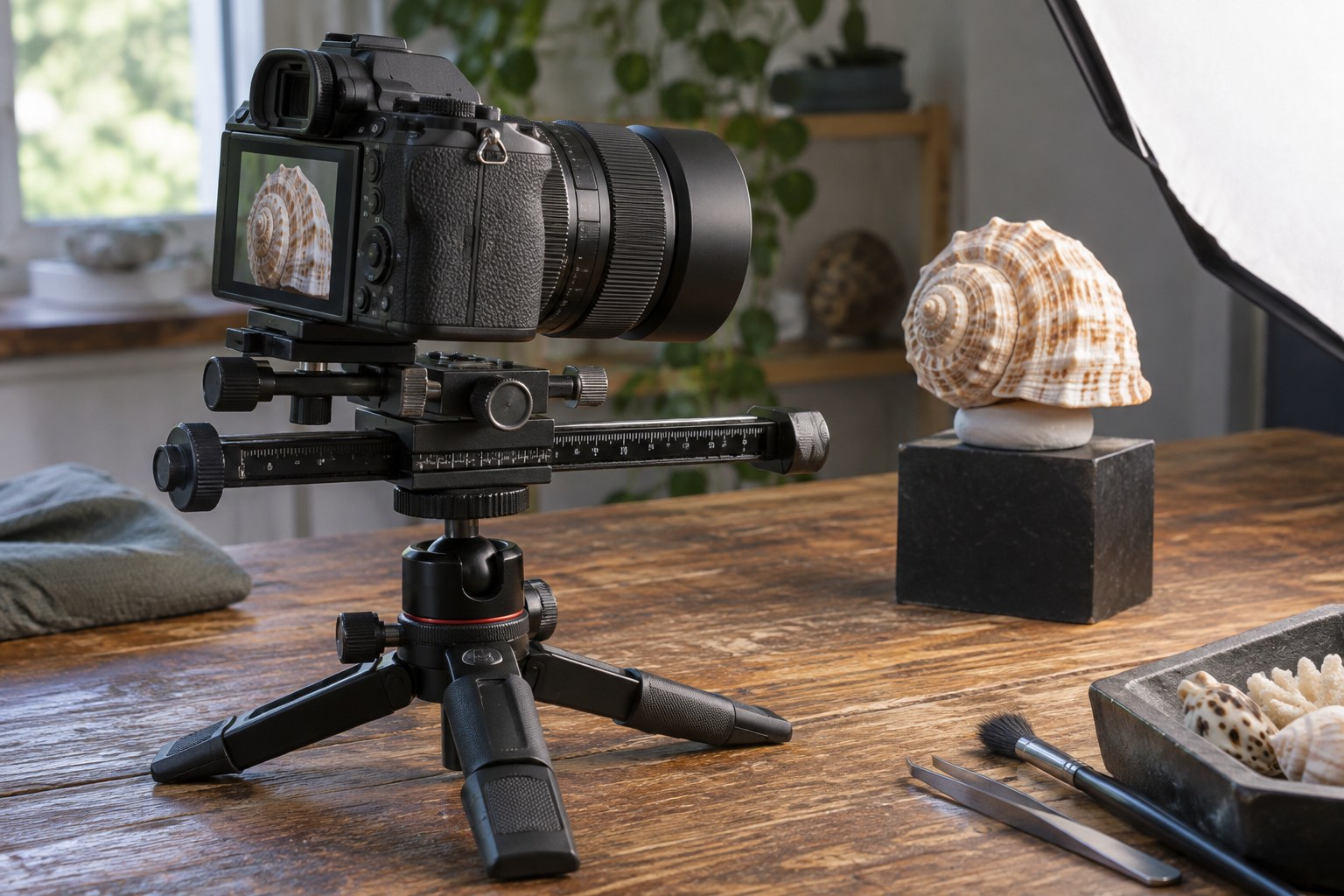
A macro support is useful when the composition changes with every small movement of your hands. At close range, moving the camera forward can shift focus noticeably, while a slight sideways movement can replace the whole background. Decide whether your main problem is camera shake, precise framing or repeated focus placement. A heavy tripod does not automatically solve all three.
For a subject on a table, first check whether the camera can reach the required height without the tripod legs hitting the furniture. A small tabletop support may work for a low object but leave too little room for lighting. A floor tripod beside the table can be easier to position. Avoid extending a centre column sideways with an unsupported load unless the equipment is designed and balanced for that arrangement.
Choose the movement you need
A head that locks without dropping is more valuable here than one that adjusts quickly but sags after tightening. Frame a small feature, lock the head and watch whether it moves. A focusing rail can make controlled forward and backward changes possible, especially for a static subject, but it introduces another connection that must be secure. It will not stop a flower moving in a breeze.
Place the support on a firm surface and keep your body from touching the table during exposure. Use a delayed release or compatible remote when pressing the shutter causes movement. Check the manufacturer's stabilisation guidance for your camera and lens on a tripod rather than applying a universal on-or-off rule. A sharp first frame is more useful evidence than assumptions about the equipment.
Lighting still determines whether the support achieves anything. If the subject moves, a long exposure can blur it even when the camera is perfectly still. Increase available light, choose a shorter exposure, or wait for movement to stop. Review detail at the subject plane, not only the background, which may appear sharp while the important part has moved.
For occasional close-ups, a securely placed beanbag or firm low support may be enough. Keep the lens controls free and avoid blocking ventilation or pressing delicate moving parts against the support. Before buying additional hardware, record the camera height, working distance and type of adjustment you could not achieve. Those dimensions make the choice concrete.