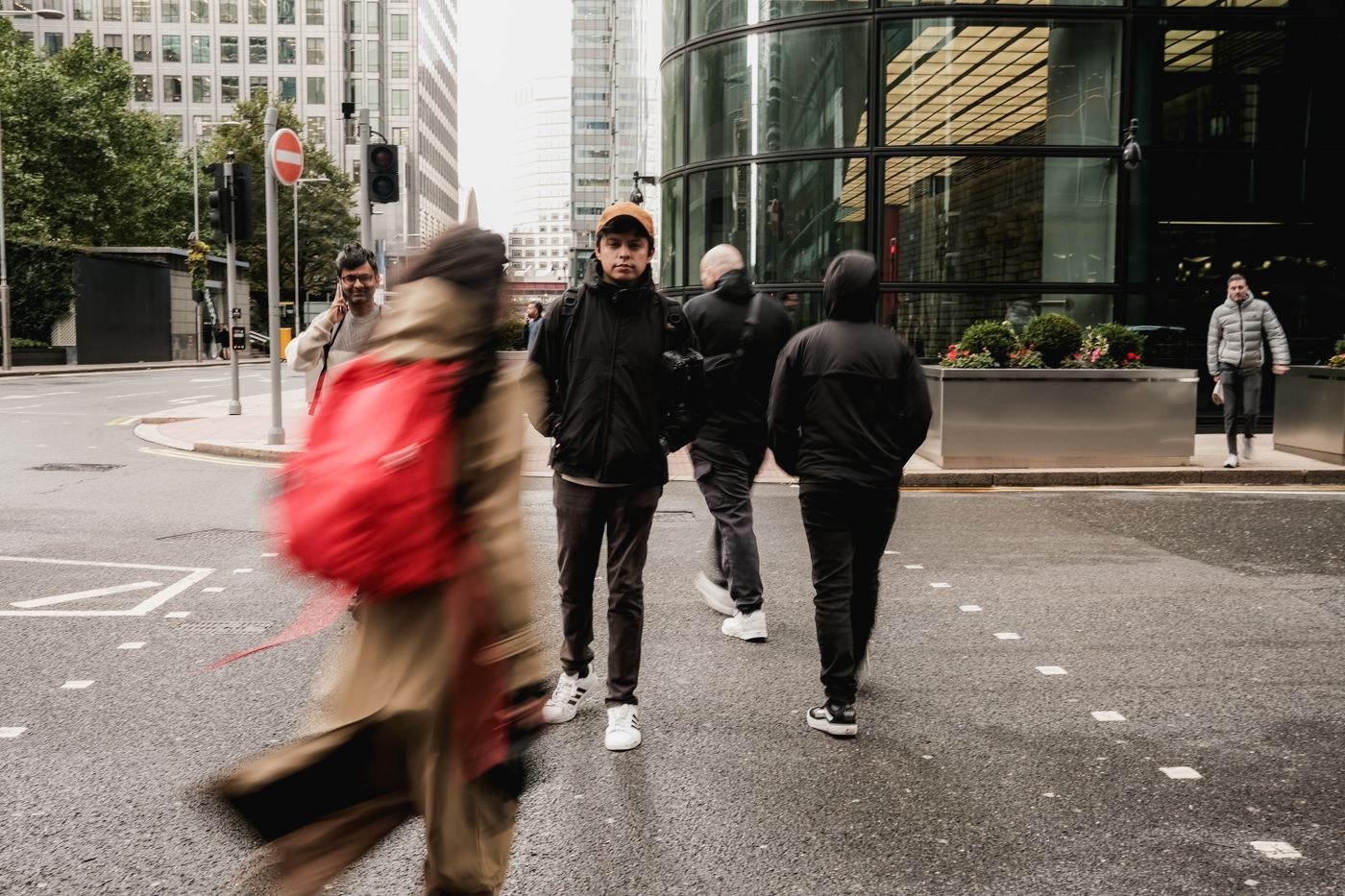
Deliberate motion blur works best when the viewer can understand the movement. That may mean a sharp building behind passing people, a recognisable person against a streaked background or repeated vertical lines made by moving the camera through trees. Choose one idea first. An arbitrary long exposure with everything moving can become visual noise rather than an expressive photograph.
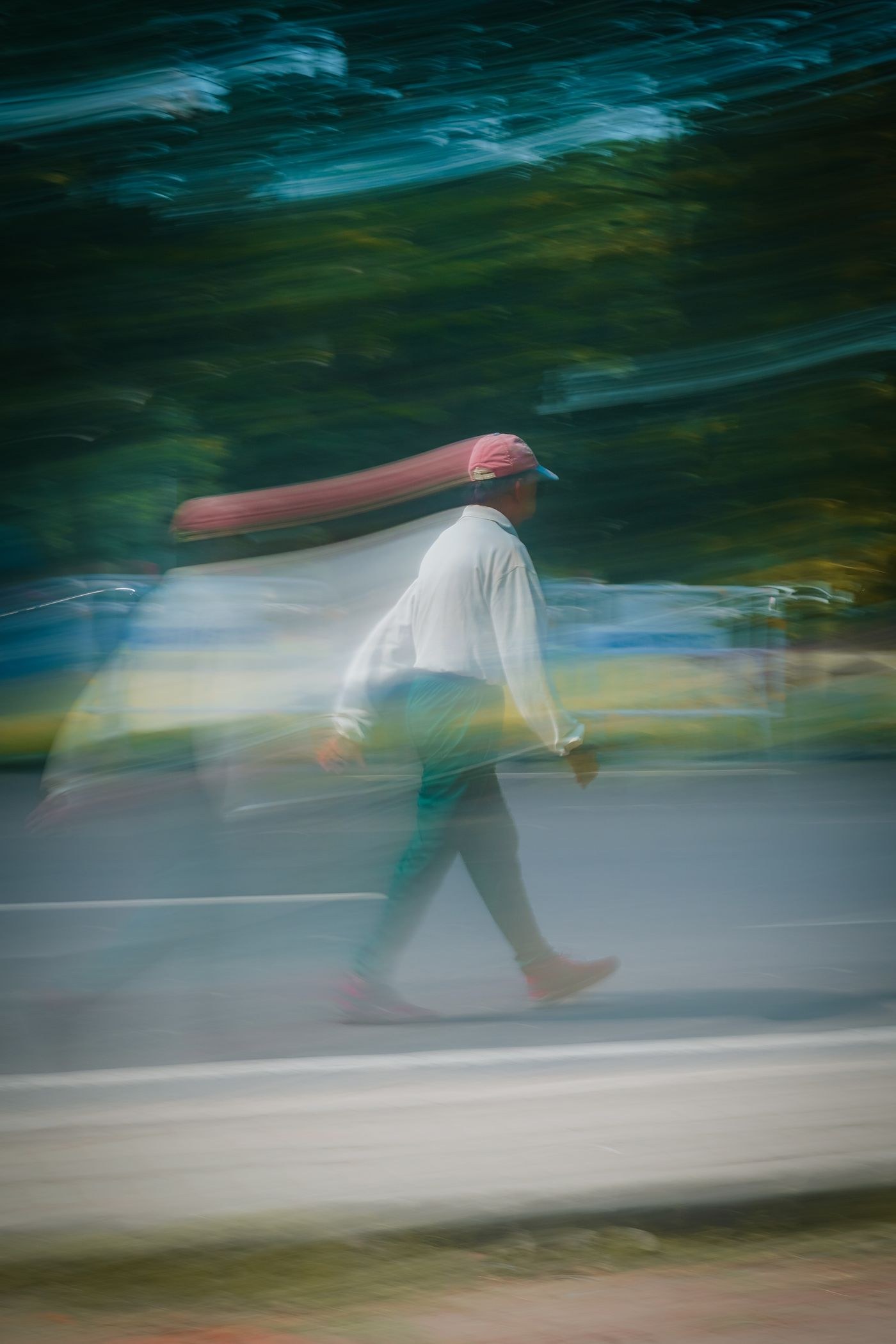
For a stationary-camera approach, find a stable reference and let the subject move through it. Support the camera and use a longer shutter time than you would for freezing the action. Make a sequence with increasingly long times while maintaining similar brightness. Watch how the moving subject changes from a recognisable figure to a translucent trace.
Decide what must remain readable
If the person or vehicle should remain identifiable, stop lengthening the exposure before its shape disappears completely. A face may be unnecessary when posture or colour carries the idea, but there should be some clear anchor. Look for a beginning and end to the blur within the frame rather than a bright smear that runs into every edge.
For intentional camera movement, start with a simple scene containing strong repeated forms. Move in a direction that relates to them: vertical movement through straight trunks creates a different structure from a sideways sweep across water. Begin the movement smoothly and keep it controlled during the exposure. Review several attempts because small variations in speed change the result substantially.
Bright areas can dominate a blurred image. A small lamp becomes a long line, and a patch of sky may spread across darker shapes. Compose with those paths in mind. Reduce exposure or remove the bright element from the frame if it overwhelms the intended pattern, but do not assume that darkening alone will fix a poorly placed streak.
In bright daylight, a neutral-density filter can allow a longer exposure without using an extreme aperture. Make a reference without the filter and check the filtered image for colour changes or uneven darkening. Keep the lens and filter clean because strong highlights can make marks more visible.
Select the final frame by its structure at normal size. Sharpness is not the main criterion, but coherence still matters. The blur should create direction, rhythm or a sense of duration. Keep one crisp reference from the same scene so that you can judge whether the motion version adds an idea rather than merely removing detail.