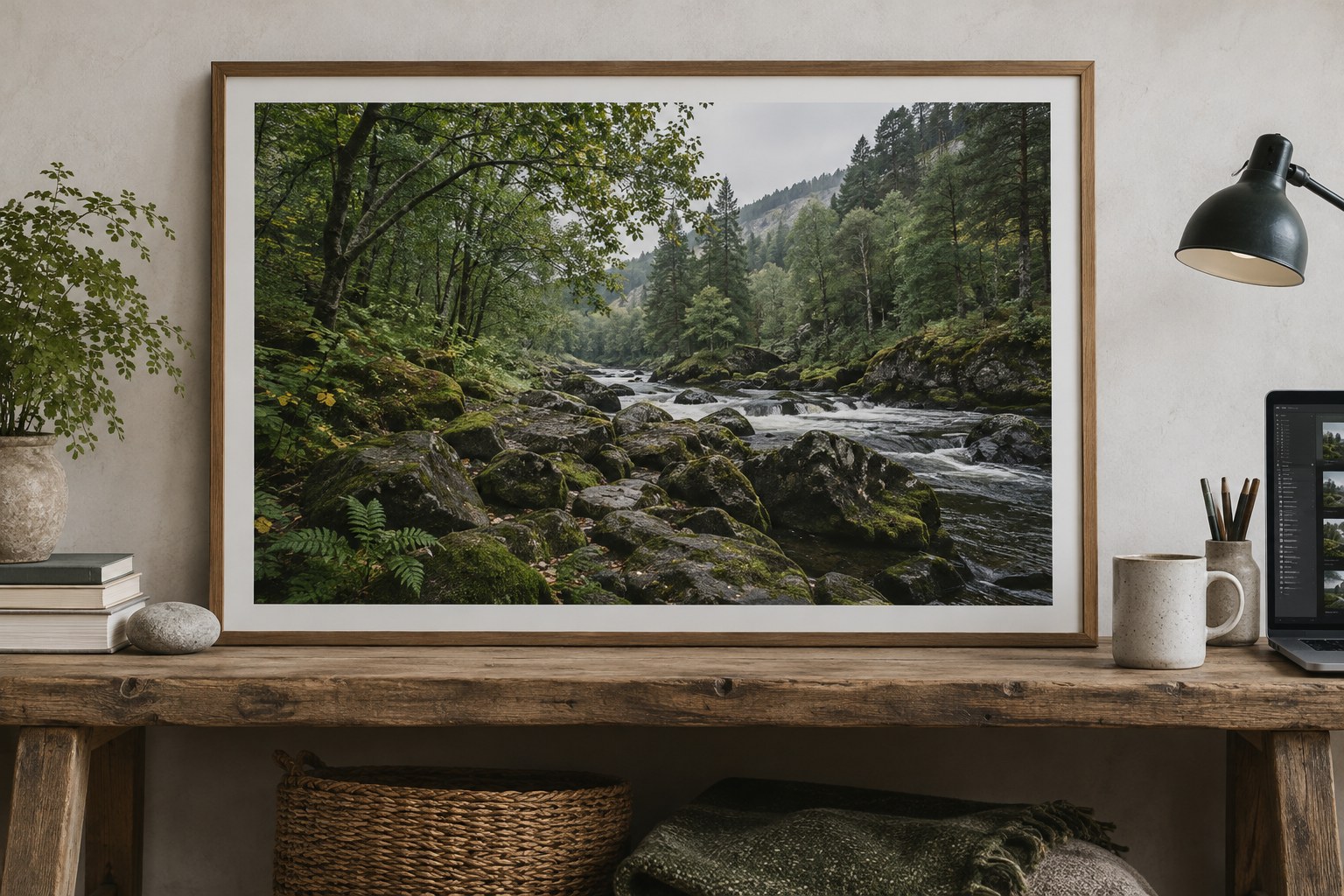
Start by finding the main structure of the photograph: a path, a trunk, a clearing or a particular group of leaves. Colour should support that structure. If the scene is already visually dense, increasing green saturation everywhere can make it harder to read by giving every small leaf the same emphasis.
Set white balance using a plausible interpretation of the light. Woodland shade can be cool, while foliage reflects green light onto nearby surfaces. A grey object under that reflected light is not necessarily a neutral reference for the whole image. Compare bark, ground and sky gaps before making a large global correction.
Separate greens through light first
Adjust exposure and contrast so the chosen subject separates from its surroundings. A lit fern against a darker background may need little colour adjustment once the brightness relationship is clear. Avoid lifting all shadows until the layers collapse into the same tone. Dark spaces between leaves can be essential to the sense of depth.
If green hues need refinement, make small selective changes and watch yellow-green leaves as well as darker foliage. A broad hue shift can make fresh growth and mature leaves unnaturally identical. Strong luminance changes may also reveal noise or create harsh edges against trunks and sky. Compare the adjusted region with nearby materials to keep the treatment coherent.
Texture and clarity can make bark more legible, but applying them strongly across the entire frame may turn leaves into a brittle pattern. Use local treatment when the principal trunk needs definition and leave softer distant areas alone. Distance often naturally reduces contrast; preserving that reduction helps the forest retain depth.
Check bright gaps in the canopy. They can distract from the intended subject, but darkening them excessively produces grey holes or halos around branches. A restrained local correction or a modest crop may help. If the gap is a legitimate light source within the composition, allow it to remain brighter than the vegetation.
View the edit at normal size after a break. Compare it with a lower-saturation version and identify which makes the path or trunk easiest to follow. The most colourful image is not necessarily the clearest one. Keep seasonal distinctions and genuine reflected colour, while removing only the processing excess that obscures them. A woodland photograph should retain the variety of its greens rather than become one continuous fluorescent surface.