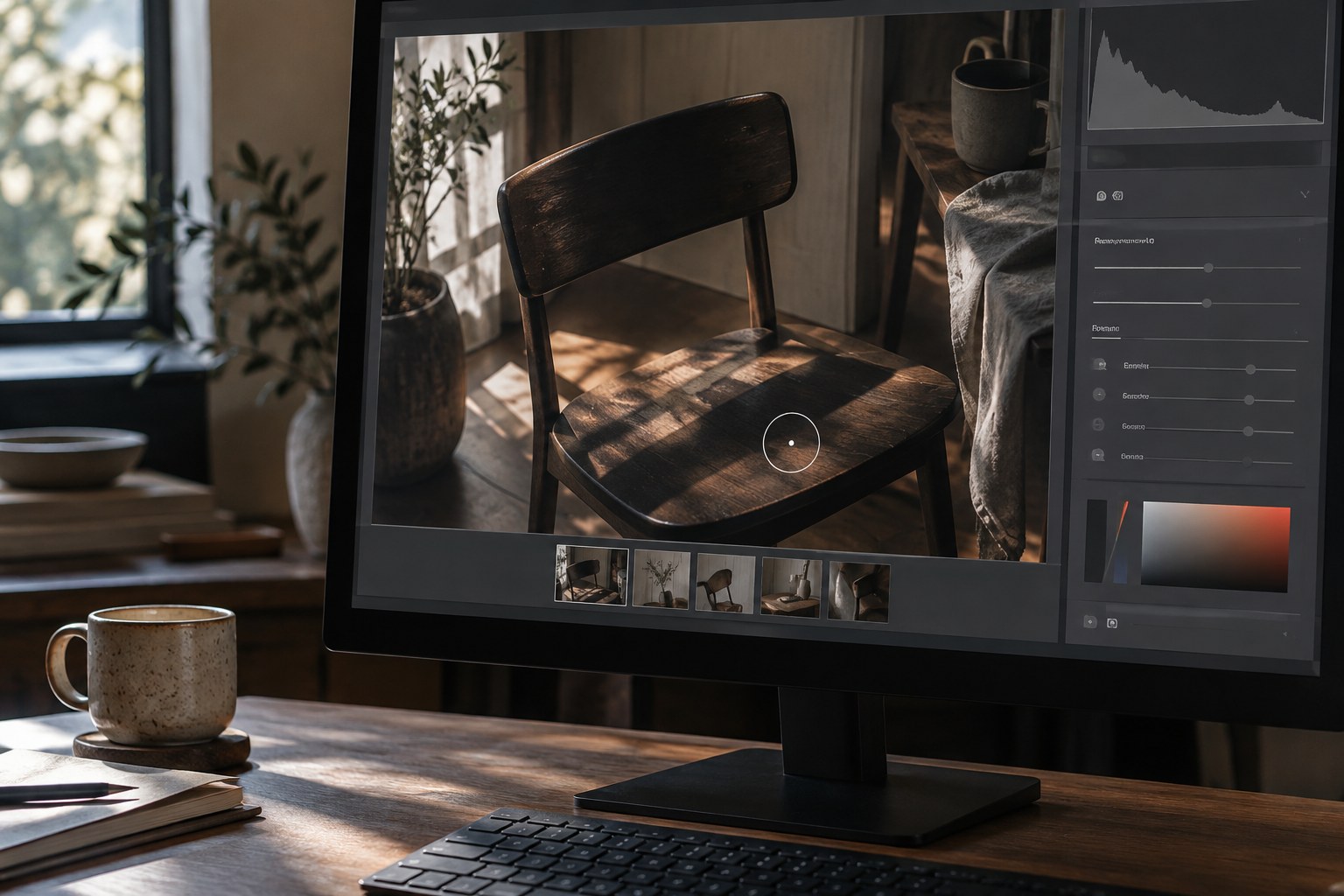
Identify why the shadow needs adjustment. You may want to show an eye beneath a hat, distinguish a tree from the ground or recover detail inside a doorway. Those are specific goals. Brightening every dark pixel equally can flatten the scene and reveal distractions that were previously held back by the lighting.
Set the overall exposure before judging shadow recovery. If the entire photograph is too dark, a global exposure change may be more appropriate than pushing only the shadow control. If the lit surfaces already look right, work more selectively. Keep a reference version visible so your eyes do not gradually accept an increasingly flat interpretation as normal.
Use neighbouring tones as a check
A shaded wall should usually remain distinguishable from the same wall in direct light. Raise shadows in small steps and compare that relationship. The objective is not equal brightness across the frame. A dark area can contain readable detail while still feeling convincingly unlit. Watch the boundary where the shadow meets the light, which often carries the scene's depth.
For a face beneath a hat, a local mask may work better than lifting every dark object in the background. Feather the adjustment so it follows the actual lighting transition. Avoid creating a bright oval that makes the face appear separately illuminated. Check hair, clothing and nearby skin to ensure the correction belongs to the same light environment.
Deep shadows may reveal noise, colour blotches or banding when raised. This is a limit of the recorded information, not necessarily an editing mistake. Inspect at full resolution to diagnose the problem, then return to the intended viewing size to judge its importance. A modest amount of grain may be less damaging than strong noise reduction that smears all surface detail.
A doorway with a dark interior
Imagine a sunlit façade with an open doorway. A small lift may reveal the door's depth and distinguish its frame from the room beyond. Raising the whole interior to outdoor brightness removes the reason it looked like a recess. Keep the inner room darker and allow the transition to explain the architecture.
If a person stands in that doorway, the face may deserve a separate restrained adjustment. Compare it with the frame and nearby wall; it should not appear brighter than surfaces receiving direct sun unless another light source explains that difference. This check is more useful than aiming for a particular shadow-slider value. It connects the edit to the scene's physical light rather than to a generic recipe.
Keep a black reference where the scene needs one
After lifting shadows, look for a suitable dark anchor such as a deep recess, a pupil or a small gap between objects. It need not be pure black, and not every image requires the same tonal range. The point is to avoid shifting the entire dark half of the picture into indistinct middle grey. Adjust the lower tonal boundary carefully rather than crushing the newly revealed detail again.
Colour can become unexpectedly strong in recovered shadows. Reflected green light under trees or warm light from a nearby wall may be real, while severe magenta or green patches may be noise or an exaggerated correction. Compare with adjacent surfaces and reduce the local adjustment if the colour cannot be made plausible without heavy treatment.
Toggle the edit while viewing the entire photograph. Ask whether the subject is easier to understand and whether the direction of illumination remains obvious. If both lit and shaded areas now demand equal attention, reduce the recovery. Export a test for the intended screen or print size; a shadow that looks open on a bright editing display may reproduce differently elsewhere. Retain a reversible version rather than baking the strongest correction into the only master.