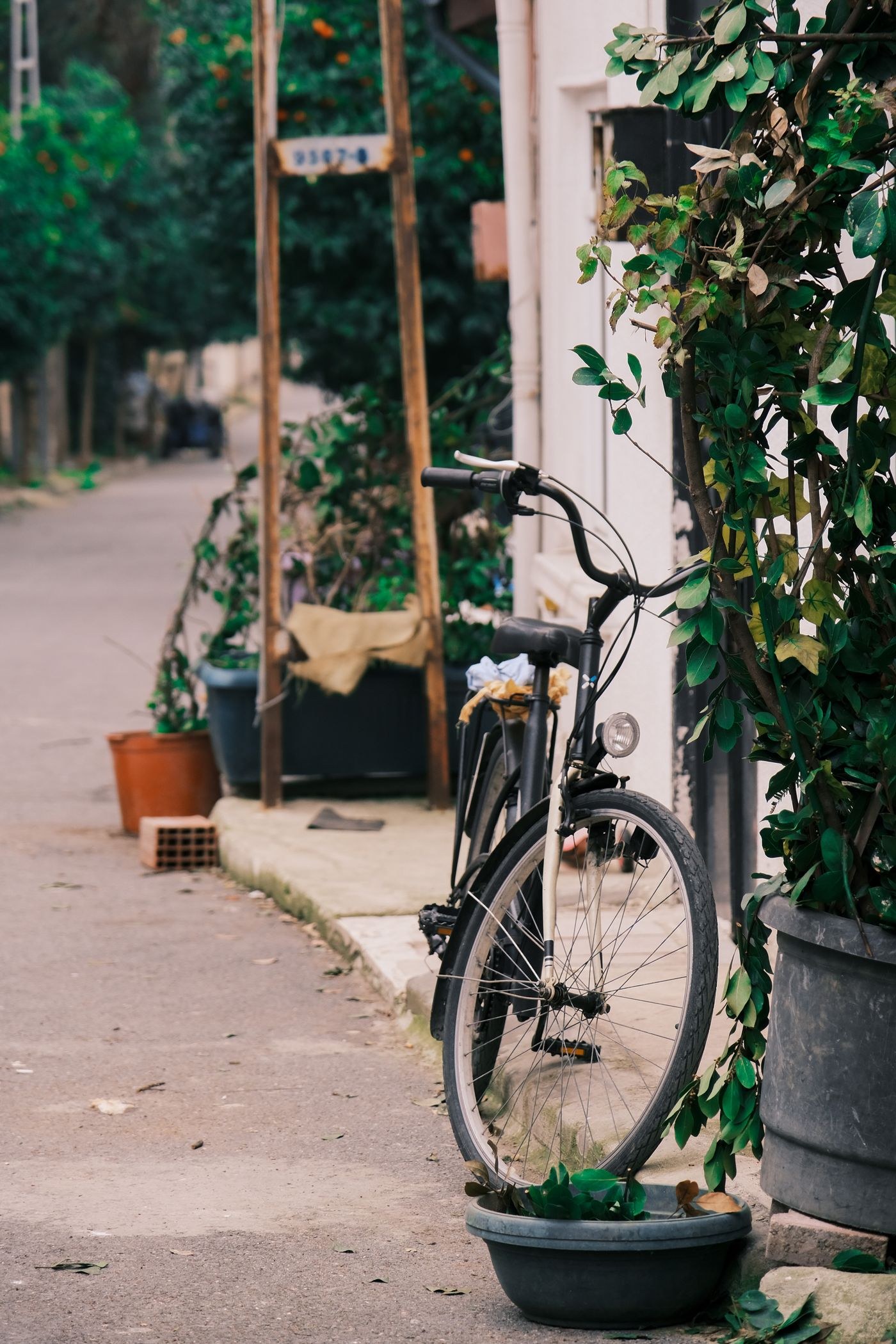
Choose a bicycle that already belongs visibly to the scene: beside a café, against a textured wall or near a doorway. Do not move someone else's bicycle to improve the arrangement. Start with enough surrounding space to explain why it is there. A tight frame may show the bicycle clearly but lose the relationship that made the location distinctive.
Look at the wheels before the finer details. Their circles provide strong shapes, and a slight viewpoint change can separate them from railings or door frames. If the bicycle leans against a wall, watch for handlebars merging with signs or plants. The photograph becomes easier to read when its main outline is not interrupted at every point.
Decide whether colour or structure leads
A brightly coloured frame against a subdued wall can serve as an accent. In another scene, repeated wheels, shadows or a diagonal top tube may matter more than colour. Adjust the amount of background accordingly. Too much empty wall can weaken a small accent, while too little can turn the photograph into a product-style record with no sense of place.
Check the camera height. At approximately wheel-hub height, the bicycle may feel more graphic; from above, the paving and relationship to the entrance become clearer. Neither is universally correct. Make both views if they tell different stories, and avoid tilting the camera merely to squeeze the entire bicycle into a cramped frame.
Light on metal can create bright points that draw attention away from the intended subject. Move slightly or wait for a cloud if a reflection hides a useful detail. A shadow can extend the bicycle's shape across the pavement, but ensure its edge remains inside the frame if it is part of the composition.
Include signs or nearby objects only when they add relevant context, and avoid exposing personal identifying details unnecessarily. Before leaving, inspect the edges for a cut-off wheel, a stray bollard or a bright object entering from outside the scene. A successful location photograph lets the bicycle describe how the place is used, rather than making every surrounding element compete with it.