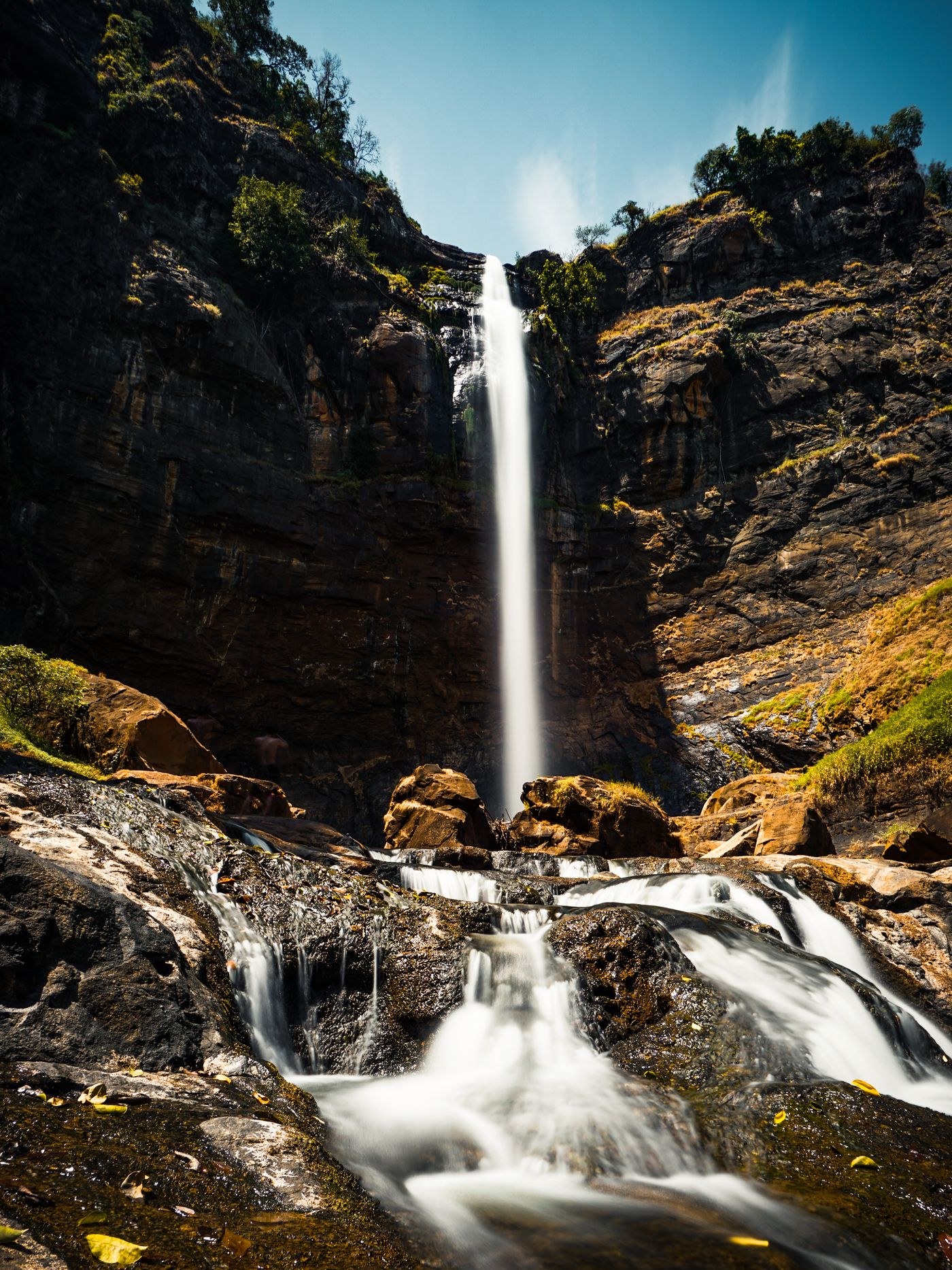
Moving water does not have one correct appearance. A short exposure can reveal separate droplets; a longer one joins their paths into lines; a still longer one may remove nearly all local texture. Choose between those descriptions before adding a dark filter. An exposure that makes a waterfall smooth can turn a small fountain into an indistinct white patch.
Find a stationary element that gives the water a scale: a rock edge, bridge support or section of riverbank. Compose it carefully and keep it sharp. Avoid placing the tripod where flowing water can undermine a leg, and work from a stable position rather than stepping onto slippery rocks for a marginally different angle.
Make a sequence with different time scales
Start with an exposure short enough to show the movement as distinct shapes. Then extend the time in clear steps, keeping the brightness approximately constant by adjusting aperture, ISO or filtration. A sequence around 1/500, 1/30 and one second can reveal very different structures, but the useful times depend on water speed, distance and framing. Treat the numbers as comparison points rather than a recipe.
Check the brightest foam after each change. A large white area with no texture may be overexposed, blurred by time, or both. The histogram and highlight warning help with exposure, while a shorter frame reveals whether the texture exists to begin with. Avoid reducing exposure merely because a reflection of the sun clips; decide whether that tiny reflection matters to the picture.
For a long exposure, secure the camera and release the shutter without pushing it. A short self-timer can be enough for a still scene. Follow the camera and lens instructions for stabilisation on a tripod, because behaviour differs. If wind moves nearby leaves, they may blur even though the rocks remain crisp. Either accept that movement, simplify the composition or wait for a quieter moment.
Review the sequence at the size you intend to show it. Fine water streaks that look interesting at high magnification can merge into a plain area in a small print. Conversely, a rough, sparkling surface may be exactly what gives a larger picture its energy. Choose the frame where the water supports the surrounding forms, not automatically the one with the longest exposure.
If daylight prevents a sufficiently long exposure at a sensible aperture, a neutral-density filter may help. Record one unfiltered reference first. It makes it easier to notice a colour shift or a new reflection introduced by the filter, and it preserves a sharper interpretation of the same scene.