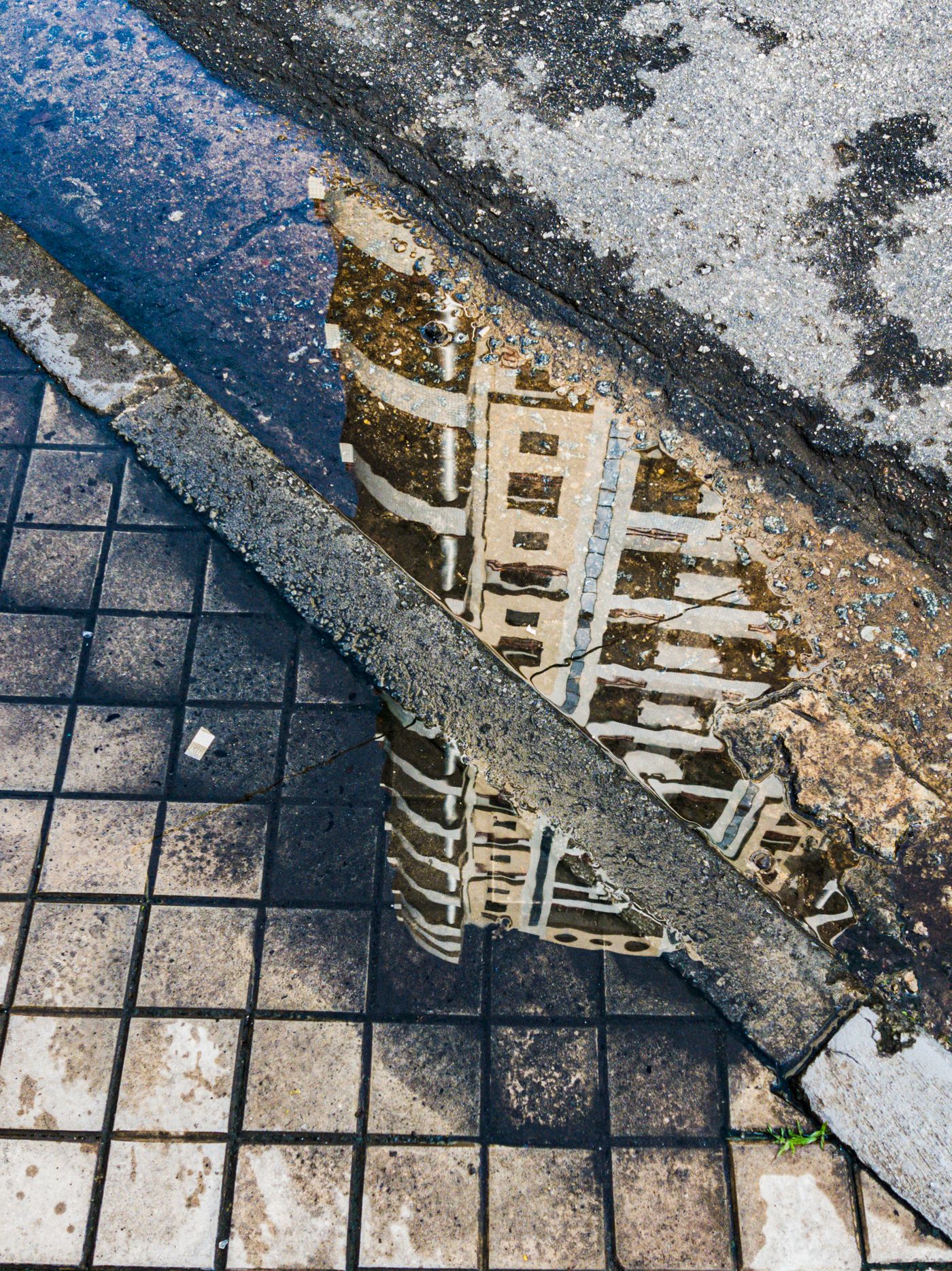
After rain, look for water that reflects something recognisable: a row of windows, a tree canopy or a lit shopfront. The largest puddle is not necessarily the most useful. A shallow strip beside a kerb can produce a cleaner composition than a broad pool crossed by litter and footprints. Start from a safe pavement position and identify the reflected subject before lowering the camera.
Move your viewpoint a few centimetres at a time. At standing height, the camera often sees the bottom of a puddle and only a sliver of reflected sky. Nearer the surface, more of the scene beyond it becomes visible. A tilting screen helps you work low without putting the camera into the water. Leave room beneath the lens and keep straps away from the wet ground; the camera should not depend on a wet railing for support.
Decide what the water adds
There are two useful starting compositions. Include both the building and its reflection when the relationship between them matters. Alternatively, fill most of the frame with reflected forms and retain a narrow strip of paving, a leaf or the puddle edge to explain the surface. Without any clue, an upside-down building can look like an accidental rotation. Neither approach requires perfect symmetry; an offset doorway or a diagonal kerb may give the picture more direction.
Check the frame edges before adjusting exposure. A bright car fragment can compete with the entire reflected façade. A small sideways movement may remove it without changing focal length. If the reflection is interrupted by ripples, wait for a calmer interval or deliberately use the disturbance as texture. A fast shutter preserves individual ripples, while a longer exposure changes moving water and moving pedestrians together. Choose which movement belongs in the photograph.
Focus on the reflected subject
The water surface and the reflected building do not share a focus distance. Autofocus may select grit at the near edge when you actually want the distant windows visible in the reflection. Place a small focus area over a distinct reflected detail and inspect the result at an enlarged view. If both foreground paving and distant reflected architecture need detail, stop down moderately and check both areas rather than assuming that focusing on the puddle will cover them.
Exposure is often easier to judge from the reflection than from the dark pavement. Watch bright sky patches and illuminated signs, particularly after dusk. Reduce exposure if meaningful bright detail is clipping, while accepting that a tiny direct reflection of a lamp may remain white. A polarising filter can weaken the reflection you came to photograph; rotate it while watching the image, or remove it if the water starts to disappear.
Make a pair of frames before leaving: one with the puddle edge clearly visible and one with a tighter reflected view. Compare them at a normal viewing size. Keep the version in which the reflection contributes a shape, colour or visual relationship, rather than simply recording that the street was wet. During editing, preserve enough difference between water and paving to keep the photograph readable. Heavy shadow lifting and local contrast can make these surfaces merge.