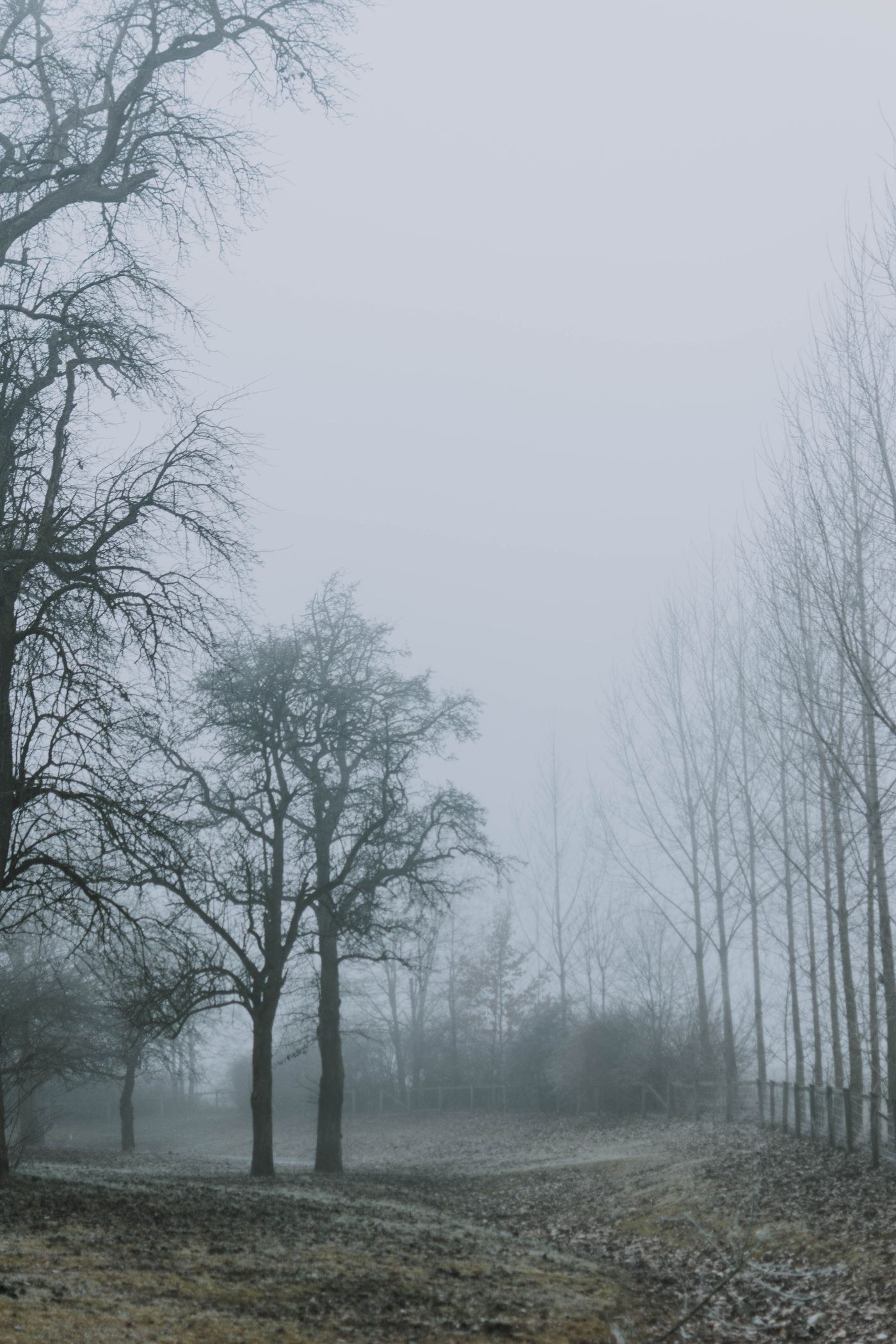
Look for a small group of trunks that remain distinct while the trees behind them fade. Fog can simplify the background, yet overlapping branches in the foreground may still make the frame busy. Move sideways until the main trunks separate, then check the edges for half-visible branches that enter without contributing to the arrangement.
Distance becomes a compositional tool. Nearby trees usually retain more contrast, while farther trees appear lighter and less defined. Use this gradual change to create depth rather than trying to restore equal contrast everywhere. A path can connect the layers, but it should lead somewhere visually useful instead of disappearing immediately behind a dominant trunk.
Keep the atmosphere in the exposure
The camera may render a pale foggy scene darker than you expect. Review the histogram and the image together, then adjust exposure so the fog remains luminous without losing important bright detail. Do not assume that every pale area is overexposed. Equally, avoid lifting exposure until thin branches disappear into featureless white.
Focus on the tree or branch that carries the composition. Autofocus may struggle with low-contrast distant shapes, so use a clearer edge or manual focus when needed. Check the result enlarged. If there is a close foreground element, choose enough depth of field for its intended role rather than leaving it accidentally soft at the bottom of the frame.
Fog can change within minutes. Make a considered frame, then wait briefly to see whether another layer appears or disappears. A denser interval may simplify the picture but remove the sense of depth; a thinner interval may reveal too much background. Keep both versions if the difference changes the structure. Protect equipment from moisture and allow it to acclimatise appropriately when moving between cold outdoor air and a warm interior.
In processing, resist treating low contrast as a defect that must be removed. Strong dehazing or clarity can bring back distracting branches and make the atmosphere look uneven. Adjust the principal trunk locally if it needs definition, then compare with the untouched image. The successful edit preserves the separation that fog created while keeping one unmistakable place for the viewer's attention.